
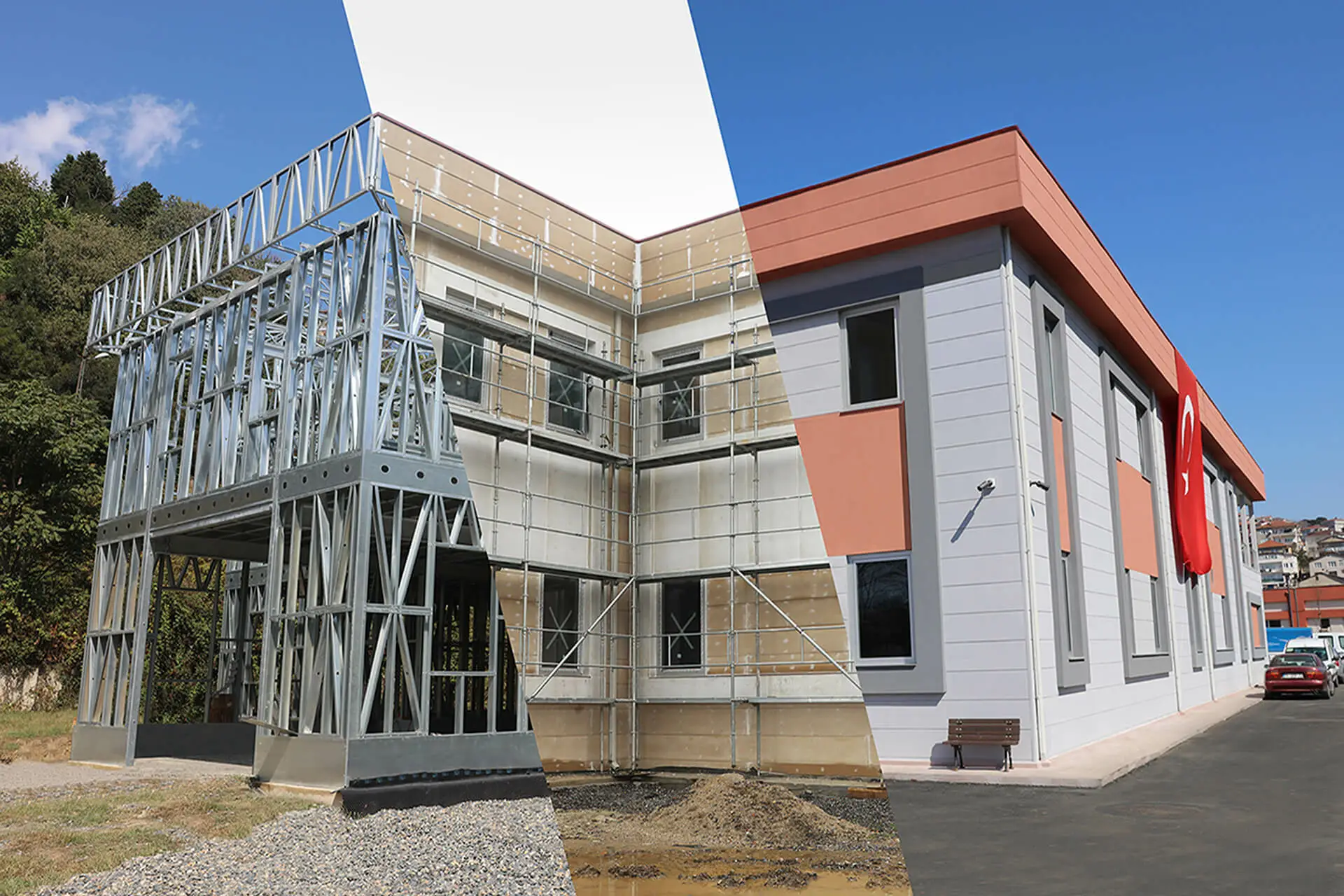
HekimBoard fibre cement boards offer a practical solution to architecture’s growing demand for innovation in an age of advancing technology. Primarily used on interior and exterior walls, they can also serve as a range of other building elements. Made from cement-based materials and natural fibres, fibre cement boards help give buildings exceptional durability. Available as flat sheets with a variety of surface finishes, they meet many of the needs of modern architecture.
Fibre Cement Cladding: A New Icon of Modern Architecture
Traditional building components are gradually giving way to a new generation of modern architectural elements. Exterior walls that deteriorate over time through exposure to rain, hail, fire, excessive moisture, heat and air pollution need durable materials that resist heat and water. Fibre cement boards are among the specialist materials designed with these damaging factors in mind. Fibre cement cladding can be installed on exterior walls without rendering. This reduces building costs and eliminates the time required for rendering. By reducing the load that render places on façades, it also prevents cracks that can develop in the building over time.
HekimBoard Fibre Cement Boards
HekimBoard fibre cement boards are made by forming materials containing natural fibres, silica and cement into sheets using specialised machinery, then sterilising them with pressurised steam in an autoclave. Although HekimBoard fibre cement boards are generally manufactured with a thickness of 10 mm, a width of 125 cm and a height of 300 cm, they can be designed to any dimensions required.
Developed by HekimBoard to meet different needs, these fibre cement boards contain no substances harmful to people or the environment. Cured at high temperatures and under high pressure, the boards also offer durability and a long service life. Completely unaffected by rain or seawater, they are also manufactured to be fully resistant to fire. As well as being unaffected by fire themselves, fibre cement boards protect the underlying surfaces from fire. Available in a range of surface finishes, including walnut, ceramic and stone effects, they lend buildings a distinctive elegance. Unaffected by climatic conditions, fibre cement boards also support thermal and acoustic insulation.
Applications of Fibre Cement Boards
Frequently chosen for garden walls, historic mansion restoration projects, public spaces, residential development entrance gateways, particularly façade cladding and interior wall cladding, front façades and suspended ceilings, fibre cement boards have virtually unlimited applications. They can be adapted and installed in any part of a building and custom-manufactured to the specified dimensions, making them easy to use across a wide range of applications.
Fibre cement boards can also contribute to a building’s insulation. When used with insulation materials to form a sandwich panel, they improve acoustic or thermal insulation performance. Providing strong support for intermediate floor assemblies, particularly in multi-storey buildings, fibre cement boards can also serve as 16 mm thick flooring material.
Fibre cement boards can also be used as jointed façade panels to prevent problems such as cracking or expansion on exterior walls, while indoors they can serve as floor or wall cladding. Used as flooring over concrete substrates, they eliminate the need for screed. Fibre cement boards are also used for soffit cladding and fascia boards, and when installed beneath the roof, they make the building watertight.
Resistant to high temperatures and pressure, the boards can be chosen as a heat- and water-resistant floor covering for terraces exposed to intense sunlight throughout the day and occasional rainfall. Their durability also makes fibre cement suitable for room partitions, cabin designs, and door and window surrounds.
